
Area Codes Serving Greensboro
Greensboro's current area-code map is simple in one sense and easy to misread in another. The city is served by the historical 336 code and the newer 743 overlay, and both codes cover the same local geography. The coverage table below is the starting point for a Greensboro area code lookup because it separates the active local codes from the older 919 history that no longer defines local Greensboro numbers.
| Area Code | Greensboro Role | Coverage | Dialing Impact |
|---|---|---|---|
| 336 | Historical primary Greensboro and Piedmont Triad code | Greensboro, High Point, Winston-Salem, Guilford County, Alamance County, Rockingham County, Randolph County, Davidson County, Davie County, Stokes County, Surry County, Wilkes County, Yadkin County, Alleghany County, Ashe County, Caswell County, and nearby North Carolina communities | Local calls require the area code plus the seven-digit number because 743 overlays the same territory. |
| 743 | All-services overlay for the same local numbering area | The same geographic footprint as 336; a 743 number can be assigned anywhere in the Greensboro and Triad overlay region | Mandatory 10-digit dialing applies, and a 743 number can be fully local to Greensboro. |
| 919 | Historical predecessor only | Former broad central and eastern North Carolina code that included Triad areas before later relief | Not a current Greensboro local area code, except where a separate office outside Greensboro still publishes a 919 number. |
The 336 code is the older Triad identity code, while 743 is the active overlay placed on top of the same service area. That means a Greensboro resident, government office, school, hospital, business, or VoIP line may publish either code. The code alone does not divide downtown Greensboro from north Greensboro, east Greensboro, the airport area, or nearby Guilford County communities.
The practical rule is that Greensboro local calls should be dialed with 10 digits. The 743 overlay began with a permissive transition period on October 24, 2015, when callers could adjust to full-number dialing. Mandatory 10-digit dialing began April 23, 2016, and new 743 central-office codes became available in May 2016. Older public directories still show many 336 numbers because city, county, school, university, and health-system listings had long-established 336 prefixes before the overlay.
Greensboro Area Code Coverage by Neighborhood
Greensboro is an all-overlay city for current area-code purposes. Every neighborhood listed below is served by both 336 and 743, and neither code is a reliable neighborhood marker. A 336 number may belong to a newer mobile subscriber after reassignment or portability, and a 743 number may belong to an established local office that received a newer assignment. Use the area code as a regional clue, then verify the organization, address, or official directory listing from a trusted source.
- 27401 downtown, College Hill, and Fisher Park - 336 and 743 share the same local coverage.
- 27403 UNCG, Lindley Park, and Glenwood - campus, residential, and business numbers may use either code.
- 27405 northeast and east Greensboro - 336 remains common, but 743 is equally local.
- 27406 southeast Greensboro - local numbers can appear under either area code.
- 27407 west and southwest Greensboro - the overlay applies across the same streets, offices, and businesses.
- 27408 Irving Park, Starmount, and Friendly Center area - both codes are normal local assignments.
- 27409 airport and western Greensboro - airport-area employers, hotels, and logistics offices may publish either code.
- 27410 northwest Greensboro and 27455 north Greensboro - residential growth and public-service routing sit inside the same 336/743 overlay.
Nearby Guilford County communities such as High Point, Jamestown, Summerfield, Oak Ridge, McLeansville, Pleasant Garden, and Sedalia also sit within the same overlay environment. For a Greensboro user, the important point is not whether the number begins with the older code or the newer code. The more useful question is whether the listing came from a city, county, school, utility, hospital, university, or carrier source that can be verified.
Overlay vs Split in Greensboro
Greensboro's current area-code structure is an overlay, not a split. That distinction matters because a split would have carved the region into separate code territories and forced some existing subscribers to change numbers. The 743 overlay avoided that disruption by placing a new code over the same 336 geography. Existing 336 numbers could stay in service, and new assignments could use 743 wherever numbering supply was needed.
- NPA
- Numbering Plan Area. In everyday use, this is the area code, such as 336 or 743 for Greensboro local numbers.
- NXX
- The three-digit central-office or prefix code after the area code, such as 373 in 336-373-CITY. It is a clue, not proof, because numbers can be ported.
- Overlay
- A second area code added to the same geography. Existing numbers usually keep their area code, and new numbers can use either code.
- Split
- A relief method where one part of a region keeps the old area code and another part receives a new code.
For Greensboro, the overlay model explains why 336 still dominates many older public listings while 743 remains a normal local code. It also explains why a directory should publish complete 10-digit numbers rather than assuming that a familiar seven-digit local number will connect.
Dialing Rule for Greensboro
Greensboro has required 10-digit local dialing since April 2016 because 743 overlays 336. A local call should be dialed as area code plus seven-digit number, even when both callers are inside Greensboro or nearby Guilford County. Some carriers may still accept a leading 1 for certain toll calls, and mobile phones often accept saved numbers in +1 format, but the core local directory standard is the full 10-digit number.
Important: Dial Greensboro local calls with 10 digits. Seven-digit dialing is no longer the dependable local-call format after the 743 overlay.
The full Greensboro phone codes reference covers N11 service codes, star codes, toll-free prefixes, and international dialing formats that sit outside the geographic area-code question.
History of Greensboro Area Codes
Greensboro's phone history follows the broader North Carolina Bell System pattern. Local service grew through Southern Bell and BellSouth infrastructure before competitive local exchange carriers, wireless carriers, cable voice, and VoIP providers changed how numbers were assigned and used. The city's modern public identity is closely tied to 336, but Greensboro was not always a 336 city. In the original North American numbering era, the Triad was part of a much larger numbering arrangement that relied on 919 before later relief created more focused regional codes.
| Year | Event |
|---|---|
| 1947 | 919 was one of North Carolina's original North American Numbering Plan area codes and covered a large central and eastern part of the state, including Triad communities before later relief. |
| 1997 | 336 split from the existing North Carolina code map to create a dedicated Piedmont Triad and northwest North Carolina NPA. Greensboro moved into 336. |
| 2015 | Permissive 10-digit dialing began for the 743 overlay on October 24, giving Greensboro callers time to update stored numbers, printed lists, and phone systems. |
| 2016 | Mandatory 10-digit dialing began April 23, and 743 central-office codes became available for new assignments in May. |
| 2021 | The FCC's national 988 implementation reinforced 10-digit dialing in affected NPAs, but Greensboro already used 10-digit dialing because of the 743 overlay. |
The overlay helped avoid the most disruptive part of area-code relief. Existing letterhead, school contact sheets, hospital phone trees, business signs, public-agency directories, and resident address books did not have to be rewritten with a replacement area code. The behavioral change was still real: a remembered number such as a city 373 line needed the full 336 area code in front of it, and newer 743 numbers needed to be treated as local rather than unfamiliar.
Local Exchange Prefixes in Greensboro
The NXX prefix is the three digits after the area code. In Greensboro, several official directory patterns are useful clues. City of Greensboro numbers often use 336-373, including the Contact Center number published as 336-373-CITY. Guilford County government frequently appears under 336-641, Guilford County Schools under 336-370, UNCG under 336-334, North Carolina A&T under 336-285, and Cone Health under 336-832. Older downtown and central Greensboro business patterns include 336-272, 336-274, and 336-275.
Those prefixes should not be treated as proof of identity. Number pooling, VoIP, wireless assignment, and local number portability mean an NPA-NXX can survive a carrier change or move into a hosted phone system. A 336-373 listing is a strong public-directory clue when it appears on the City of Greensboro website, but a spoofed caller ID can display an official-looking prefix. For NPA-NXX confirmation, use NANPA central-office code reports and official agency pages before relying on static prefix assumptions.
Future Area Codes Planned for Greensboro
No separate future Greensboro relief code was located in the current research materials. The active relief structure is the 336/743 overlay, and the recent area-code status remains mandatory 10-digit dialing rather than a new Greensboro-specific code. If numbering exhaust later requires additional relief, the public process would normally involve NANPA planning data, carrier input, regulatory filings, and state-level telecommunications oversight.
The North Carolina Utilities Commission is the state regulatory touchpoint for telecommunications oversight, while NANPA administers numbering resources under the North American Numbering Plan. For most residents and businesses, a future overlay would usually mean updating dialing habits, stored contacts, alarm systems, PBX settings, printed forms, and public directories. It would not automatically mean that existing Greensboro subscribers lose their numbers.
The North Carolina Utilities Commission telecommunications page is the manifest source for the state oversight screenshot below.
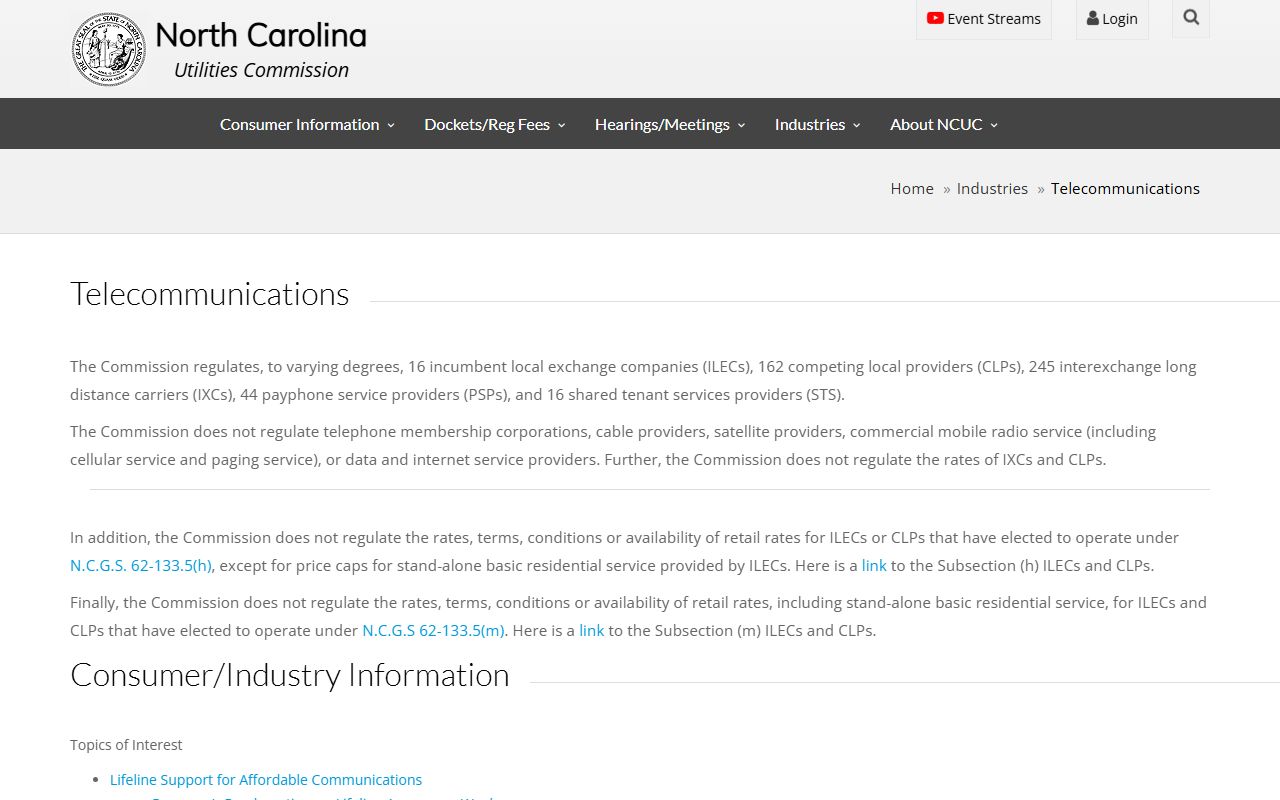
The NCUC telecom page helps connect Greensboro's local area-code rules to the state oversight framework behind numbering relief and carrier regulation.
Verifying a Greensboro Area Code
Use three official layers when checking Greensboro area-code information. NANPA's geographic area-code report confirms which NPAs are assigned to North Carolina and what geography they serve. NANPA central-office code reports add NPA-NXX context when a prefix needs closer review. The FCC's 10-digit dialing reference explains national dialing changes, including the 988-related background that affected many area codes. The North Carolina Utilities Commission provides the state regulatory context for telecommunications oversight and consumer-facing telecom information.
Verification is especially important for caller ID. A displayed 336 or 743 number may be a real Greensboro-capable number, a ported number, a VoIP line, or a spoofed number chosen because it looks local. When a caller claims to represent a city department, county office, school, university, utility, or hospital, compare the number against the organization's official website or call the main published switchboard from that source. Do not use low-quality people-search listings to verify public-agency identity.
The North Carolina Utilities Commission homepage is the manifest source for the second successful area-code screenshot.
The commission homepage is a starting point for state telecom materials, while NANPA and FCC pages remain the direct sources for area-code assignment and federal dialing-rule references.